
Happy Friday!
I went to see Michael Lewis being interviewed by Elizabeth Day at the Southbank last week, and he said something that has stuck with me since. (Side note: Day’s cosy interviewing style was impressively syrupy; at the end, she told him something along the lines of it’s a privilege to be alive and writing and thinking at a time when you’re alive and writing and thinking.) He talked about being blown away by how good Christian Bale was at playing the trader Michael Burry in The Big Short—here was a guy that no one had heard of, and yet Bale bothered to capture his personal style and mannerisms with uncanny precision.
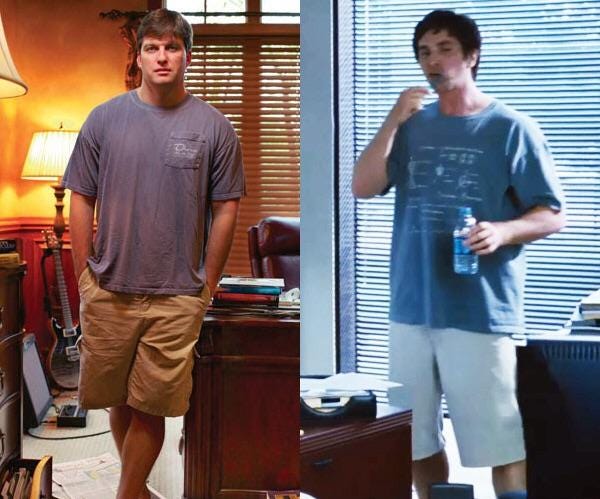
Lewis asked the trader what he had made of Bale. He’s weird, said Burry (who is himself a little . . . orthogonal to normality). He just sat in my office and watched me for 12 hours without saying anything. Then he asked me for my T-shirt and shorts to wear in the movie.
Intrigued, on the press tour, Lewis badgered Bale to tell him what he had noticed about Burry during all those hours spent observing him. What had allowed him to capture his essence so precisely?
Look, said Bale eventually, he breathes in the wrong places.
Lewis loved this—he had spent months with this guy and never noticed. But in that instant, he understood why Bale’s impression was so accurate, and why it communicated so effectively the fact that Burry is a little off-kilter. (The entire thesis of The Big Short is that misfits and weirdos were the only ones who dared buck the conventional wisdom that the financial system was fine, pre-2008 crash.) Now, Lewis said, whenever he profiles someone, he asks himself: what would I tell an actor who was going to play them?
I love this! In my writing rules, I made the case for why I believe that physical descriptions belong in written journalism, even though they now make people uncomfortable. Michael Burry could not have gotten promoted to the top of a big trading firm because he liked to wear cargo shorts, and he breathed wrong. But that very weirdness is what led him to make the “big short,” betting against the American housing market.
Helen
PS. Savour this Bluestocking, as I am taking November off from the newsletter. I’ll no doubt be writing something about the midterm results for The Atlantic, and I’ll be on Have I Got News For You next week. In the meantime, here’s Page 94 discussing the midterms, the PHP hack and the secret celebrity injunction.
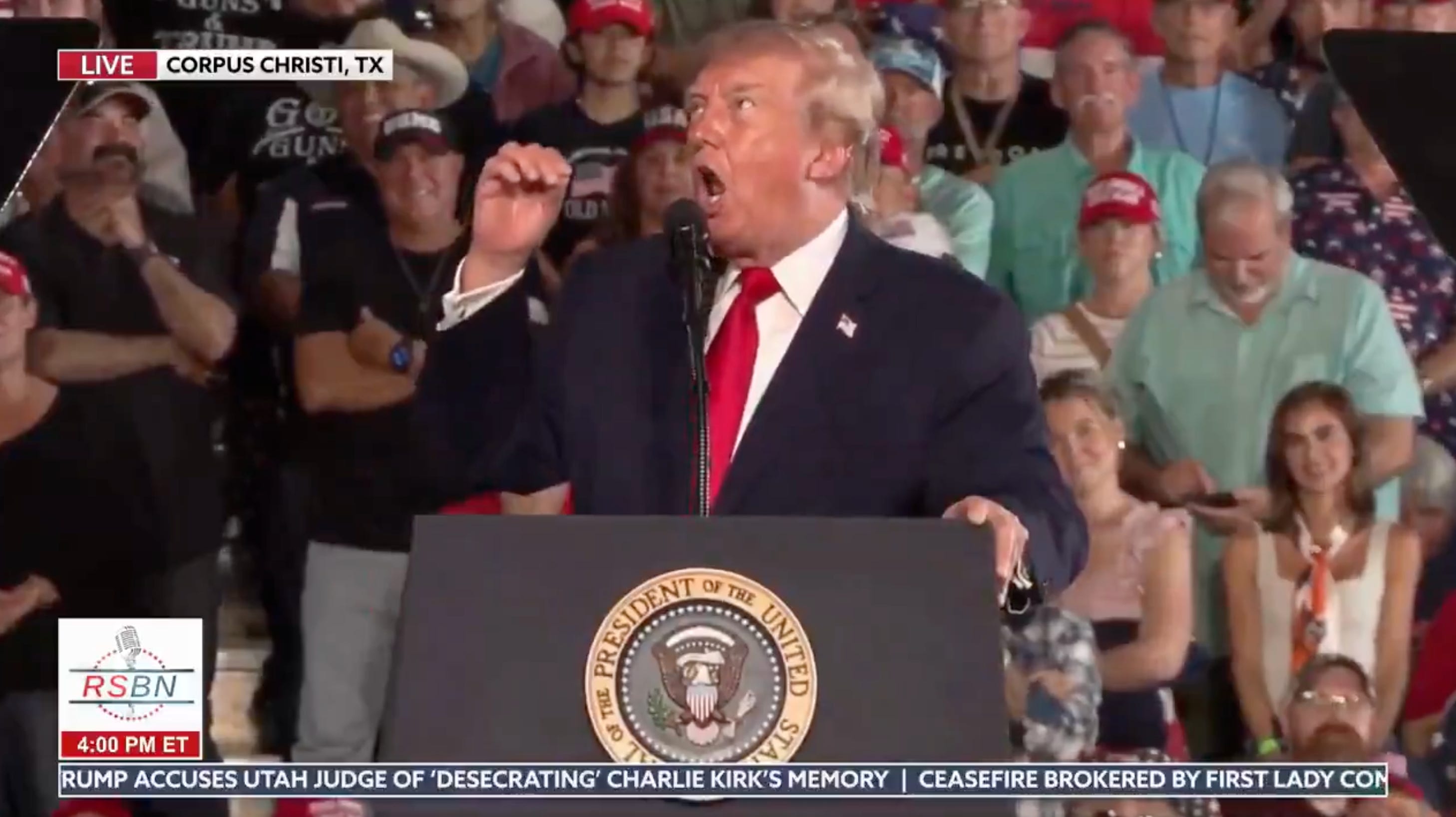
“Shove Your Ballroom Up Your Fat Ass”
She says the turning point for her was a televised cabinet meeting on July 8, 2025, when Trump shot back at an inquiring reporter, “Are you still asking about Jeffrey Epstein?...Are people still talking about this guy?” Still talking? How could he casually minimize an issue that’s such a MAGA article of faith? Trisha Hope was crushed. “I found a lot of lies, a lot of deception. He became a car salesman to me. Anything he said, I just didn’t believe.”
Tina Brown on disillusionment with Trump. I’m always fascinated by what makes people change their minds from strongly held beliefs — because it’s so psychologically costly, and therefore so rare. Getting MAGA diehards from “he’s the greatest president ever” to “he’s a used car salesman” seems like an easier off-ramp than trying to get them to agree that he’s a wannabe dictator.

The Pollycrisis
For all their splendor, the parakeets are nevertheless a bit of a scandal. Politicians, conservation bodies, land management, and the public have all begun to ask: Do we want tens of thousands of Himalayan parrots squabbling all over our cities? Across their native range, they are known as a significant crop pest. European studies suggest the parakeets have negative impacts on various native bird and bat populations. We know they vector both Newcastle disease, a viral ailment that primarily affects poultry, and Cryptosporidium, a parasite with more general tastes whose characteristic symptom in humans is violent diarrhea.
Thanks to the Browser for this tip-off—a feature on the British population explosion of ring-necked parakeets, which originally come from the Himalayas, and what they tell us about the entire discipline of “invasion biology”. Inevitably, the debate over whether the parakeets belong in the UK has acquired a political dimension, with people who want to eradicate them from London being accused, essentially, of being parrot racists.
Personally, I am quite fond of them, because they’re so obviously intelligent. I watched one on our bird feeders using its beak as a third claw to hang upside down and reach the peanuts. Equally, though, that peanut feeder was built specifically to repel big birds (and squirrels) and the parakeets did just chomp through the wire netting. Also they are fackin’ noisy. I also think that the pro-parakeet faction is being influenced by the fact they are very pretty; they are such a vivid green that they make even the grottiest Lewisham parks feel exotic. If they looked like oversized dunnocks, no one would give a toss.
I’m also influenced by visiting the Galapagos, where dozens of committed scientists are currently devoting their lives to undoing the invasion of foreign animals and triffid-like plants; soon, we hope to visit Easter Island, where the main theory for the collapse of the palm tree population is that ship rats ate all the seeds. Put me, reluctantly, in the pro-shotgun camp.
Quick Links
Anderson Cooper is definitely enjoying the Trump-ass story (X), while Fox’s Jesse Watters declares this to be the “gayest midterm ever” (Fact check: true).
Marina Hyde on Thomas Markle’s odd relationship with the Mail, and the probable Met Police screw-up in passing on the allegations against him (Substack).
“In virtually any crisis you can think of, the truth has been the other way around: the public are calm and collected while ministers and op-ed writers lose their tiny minds.” Martin Robbins on elite panic (Substack).
Dr Sarah Redvers tried to pass on safeguarding concerns against a GP at a service called WellBN, who was prescribing blockers and hormones without enough assessment and checks. For simply doing her job, she got accused of being transphobic, and obsessed with the GP. Her employment tribunal is surfacing some very unpleasant insights into the NHS trust involved, particularly since “in June 2026, nearly six years after she first raised concerns, a separate NHS safety investigation found that dozens of children, some as young as 13, had been inappropriately prescribed drugs at the WellBN practice, the clinic where the other doctor worked.” (BBC).
“Diana Simpson, 35, an Ivy league graduate who lives with her parents on Cambridge Street, is suing Westminster city council. She is applying for judicial review and potential damages on the grounds that when the embassy did belatedly seek planning permission for its change of use and flagpole, the local authority failed to take into account the impact on her mental health of the arrival next door of Montenegro, a country that has been involved in recent scrapes with Russia.” <extremely hard stare> (Guardian)
See you next time! By which time it will be December . . . You know what would make a great Christmas present? My book.
The Redvers case is shocking, and it confirms something a few of us tried to raise around a decade ago: that some of the behaviours supposedly “protecting” trans rights were actually poisoning the well. There are more scandals to come, sadly.
Orthogonal to normality may well be my phrase of the year