
What I Read In 2025
The Year Of Reading Middlebrow-ly
Happy Monday!
The New Statesman asked me to nominate my books of the year, with the stipulation that they had to be new1. This proved a bit of an issue. As I explained, it’s not been a bumper year for finding new books I loved:
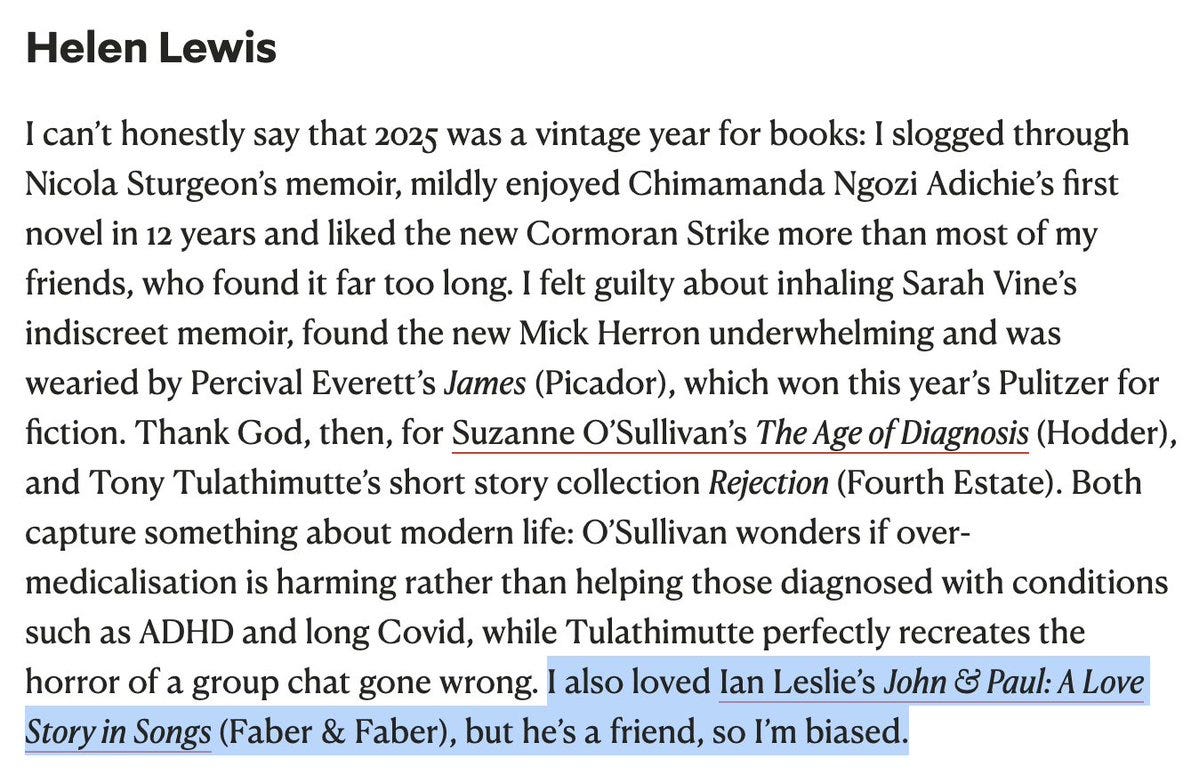
Here is my review John and Paul from earlier in the year, if you want to read that. But I thought I should give some other honorable mentions, as well as highlight some oldies that I enjoyed, in case you’re looking for Christmas gifts or things to read over the holidays. I don’t keep any kind of record of what I’ve read in a year (might try doing this next year) so I’ve probably forgotten some things I’ve previously praised. Sorry.
You will notice that I read a lot of things you might charitably call airport books. Judge me all you want; I do not care. My rationale is that, just like how anyone on the slowest run is lapping everyone on the couch, me reading any sort of book is me not doomscrolling for the seventh hour that day.
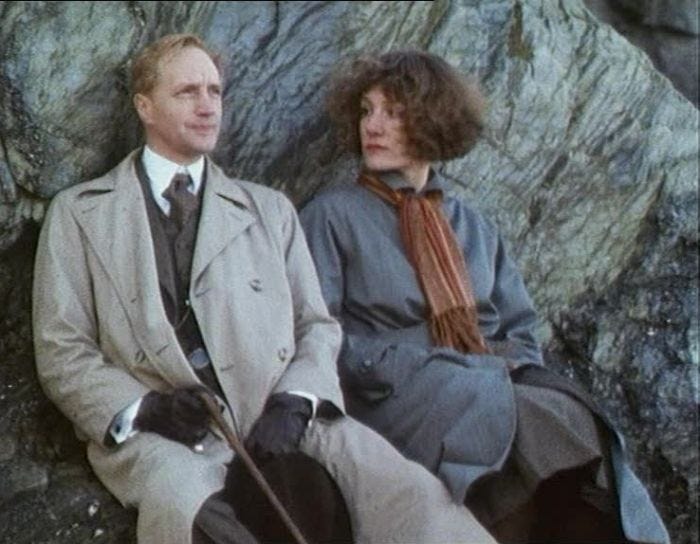
Lord Peter Wimsey, continued
Now, I love Dorothy L. Sayers, and I love her posh, courteous, PTSD-ridden detective hero, Lord Peter Wimsey. But there is no denying that her plots are occasionally numbingly bad—the one about the bicycles and the railway timetables springs to mind. Thankfully, the author they chose to write four more Wimsey novels after her death, Jill Paton-Walsh, has no such problems. She gets the character, and she can construct a beautiful mystery, too.
This year, having finally blasted through the entire Sayers canon and the first Paton-Walsh, I read the second, third and fourth Wimsey continuation novels: A Presumption of Death; The Attenbury Emeralds; and The Late Scholar. These take the story from the 1930s into the Second World War (based on Sayers’s Spectator columns) and beyond. Apart from anything else, the character development—it’s a war, lots of people die—is very moving. 10/10.
PS. The best OG Sayers novels are Gaudy Night (obviously) and Murder Must Advertise.
Shamanism: The Timeless Religion
I spent a lot of time on my book tour quoting the anthropologist Manvir Singh’s study of shamans—charismatic men who live somehow outside their societies, and can thus offer healing, insight and, well, stardust. Very interesting if you’re at all interested in the dynamics of fame, faith-healing or cult leadership. Here’s me talking to Armando about the book.
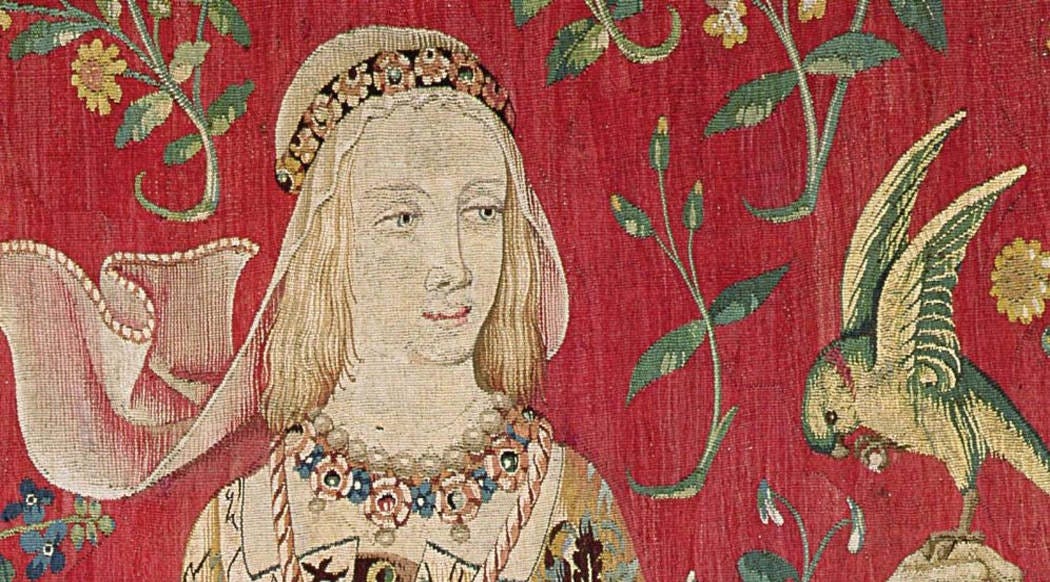
Katherine, by Anya Seton
One of the classics of historical fiction, about Katherine Swynford, the commoner who (eventually) married John of Gaunt. Not what you might call entirely true to the historical record, but an absolutely cracking yarn with gothic overtones.
Perversion of Justice: The Jeffrey Epstein Story
This is by Julie K. Brown, based on her original investigation into Epstein for the Miami Herald, which helped draw attention to the insanely generous plea deal he got from the Florida authorities when his offences were first uncovered. Brown is finally getting the credit she deserves, which I’m glad about, because as well as chronicling Epstein’s crimes and the complicity of the prosecutors, this is also a portrait of how hard and unrewarding it is to do investigative journalism in the 21st century.
I also read Nobody’s Girl, by Virginia Roberts Giuffre, which is a terribly sad companion to this.
The Hallmarked Man
As mentioned above, I found the latest JK Rowling (as Robert Galbraith) somewhat unwieldy, as she juggled several contenders for the identity of a mutilated body found in a jeweller’s strongroom. BUT BUT BUT I am beyond invested in the relationship between Cormoran Strike and Robin Ellacott, and I raced through this in record time, pausing only to shout, “it’s been 700 pages, stop edging me JK Rowling!”
I also re-read The Silkworm, Lethal White and Troubled Blood this year, so you can’t accuse me of not loving this series.
Other detective novels I read included They Do It With Mirrors and The Moving Finger, two Miss Marple stories—the first a classic posh house murder, and the second a great poison pen mystery. On the plane back from San Francisco I also re-read two of my favourite Dick Francis novels, Straight (about a jeweller) and The Edge (about a bent horse owner on a mystery train across Canada). As previously discussed, I also chomped through my colleague Adam Macqueen’s second and third Tommy Wildeblood novels, set around the Brighton bombing and Section 28.
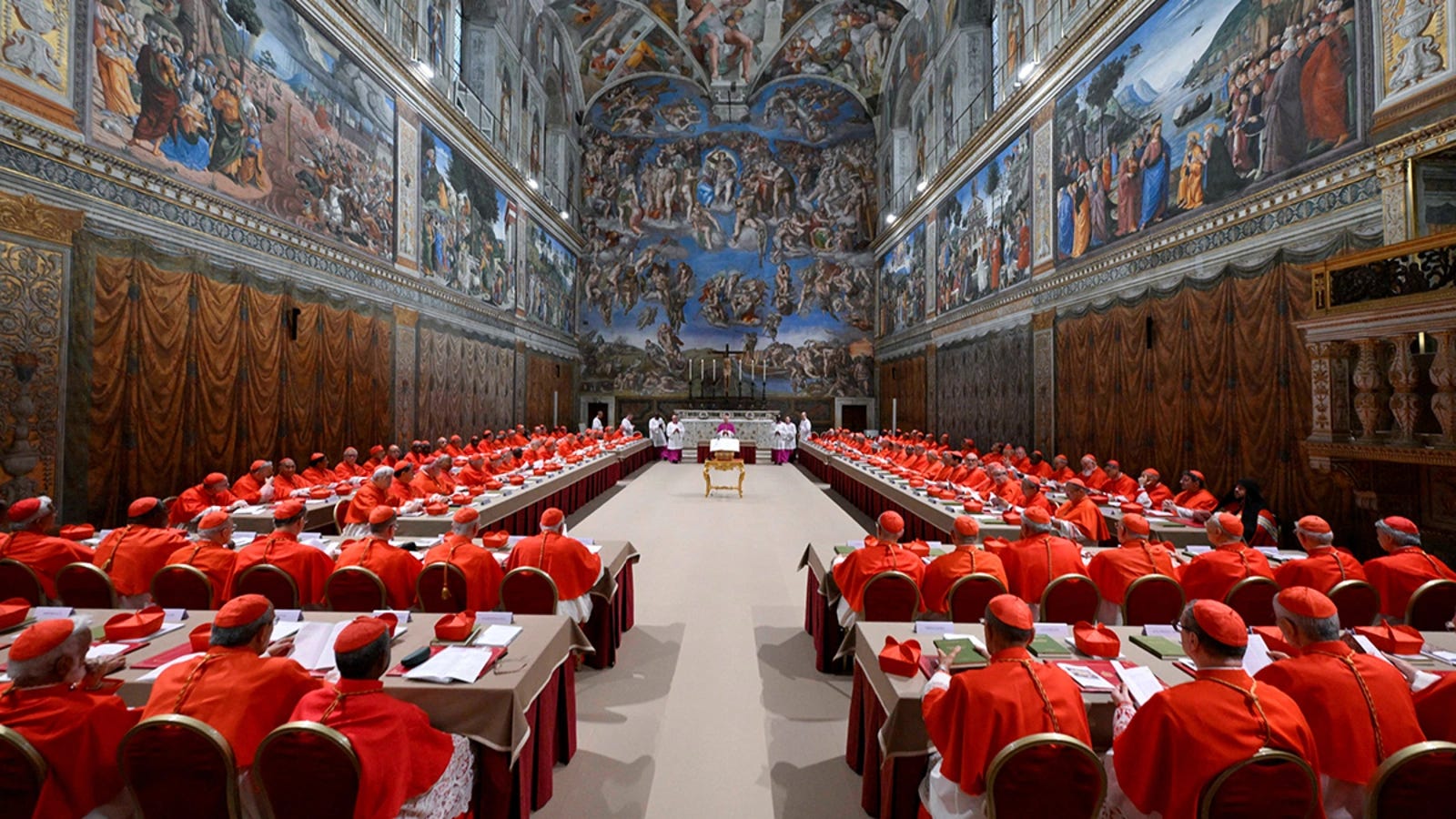
I was less enthused by Robert Harris’s Enigma (fine) and Conclave (loved the arcane details of Vatican procedure, not sure about the twist) and so I finally succumbed to Jonathan’s multiyear lobbying campaign to try Ken Follett. Eye of the Needle was pretty good, but Jackdaws was an absolute banger—a daredevil female English operative behind enemy lines in France.
My Life, Bill Clinton
I’ve been into this for work and it’s such a readable memoir. Clinton remembers the name of everyone he’s ever met—there’s a definite “school Nativity play” vibe to this—but it also covers such an interesting period of American history. I hadn’t really clocked how much Clinton’s youth was shaped by his support for civil rights in the South (at exactly the time schools were being desegregated) and the Vietnam war. On the latter subject, there’s still dispute about what exactly happened with his draft deferment; he got one for study purposes, and then gave it up, although the suggestion is that he did so once he knew the war was winding down and he was unlikely to be drafted.
I cross-checked Clinton’s version of events with the best of the Clinton biographies (according to my all-knowing colleague Leibo): First In His Class. That was, er, comprehensive, although it only goes up to his presidential campaign.
Small Bomb at Dimperley
As previously discussed, I found this charming and plan to read more by Lissa Evans.

Inside the Kingdom, Robert Lacey
To prepare for my trip to Riyadh, I wanted to read up on Saudi Arabia. This history from the foundation of the country by the Sauds up to the 2010s crackles along, gossipy but also grounded. It had a very informative chapter on lesbianism in the kingdom (pretty easy to get into, as it was traditionally so sex-segregated) and a really useful account of the siege of Mecca in the 1970s, which rattled the Sauds and led to the imposition of Wahhabism, as these secular playboys worried that fundamentalists would dethrone them.
To bring the story up to date, I read Blood And Oil, by two WSj journalists, about Mohammed bin Salman’s reform efforts, dictatorial vibes, and, er, private pleasures.
Original Sin, Jake Tapper and Alex Thompson
The definitive book on Joe Biden’s sad and precipitous decline, and the refusal of anyone around him to acknowledge it. No one on the right of American politics would write a book this damning about Donald Trump, which tells you something.

Every Living Thing, Jason Roberts
I recommended this on Strong Message Here, but the short version is that this is a history of the birth of taxonomy, and the rivalry between Linnaeus and du Buffon. Linnaeus wanted to come up with a fixed set of categories into which nature could be neatly divided, including, disastrously, the four “races” of humans: European white; American reddish, i.e. native Americans; Asian tawny; African black.
Du Buffon had a more fluid, dynamic vision. But Linnaeus won.
Pratchetts
Inevitably, I reread some Terry Pratchetts. This year, it was Maskerade (the Phantom of the Opera parody) and Making Money (the creation of the Royal Mint, part of the Industrial Revolution series).
For balance, here are the books I didn’t get on with, or bailed out from:
Erotic Vagrancy: Everything About Richard Burton and Elizabeth Taylor, Roger Lewis: this had great blurbs but I felt like it was a machine-gun of facts without enough narrative grouting, and eventually that made me feel kind of seasick.
Empire of AI, Karen Hao. A good account of the Sam Altman brouhaha, but I sensed we were not politically as one when Hao put brackets inside Hyman G. Rickover’s famous quote so it read like “Admittedly, one [person] by [themself] cannot do the job.” Come on! I can handle that they didn’t use inclusive language in nuclear submarine research in the mid-twentieth century!
The Murder At the Vicarage. The first Miss Marple. Irritating first person narrator threw me off.
James, Percival Everett. Had a very good premise—what if the slave from Huckleberry Finn was just putting on a blaccent in front of whites—but ran out of steam. (His Erasure, which was filmed as American Fiction, is great, though.)
Heiresses, Laura Thompson. This Substack is pro-Thompson—her Mitfords work is incredible—but group biographies are tricky beasts and I didn’t enjoy this history of girls with money as much as her other work. Read her wonderful Take Six Girls instead.
Ravenous, Andrea Zuvich. This biography of Barbara Castlemaine, mistress of Charles II, suffered from the paucity of primary
saucessources2. I think Castlemaine was probably a magnificent monster, but there is just not enough stuff on record for this to work. Someone, please write some historical fiction about her!Frankly, Nicola Sturgeon. As mentioned at the top, it didn’t really tell me anything I didn’t know about Sturgeon.
The Corner That Held Them. A book about medieval nuns in which nothing much happens for centuries on end. Very much the same problem as 100 Years of Solitude or Waiting For Godot, where my little attention-deficit brain is like: yes, yes, a profound meditation on the rhythms of life, but also: are we nearly there yet?
And that’s your lot. Want something more highbrow? James Marriott appears to have spent the year reading fat history books about the Enlightenment and the Bhagavad Gita in the original Sanskrit, but that’s because he doesn’t own a smartphone. Caroline Crampton does monthly reading updates (show-off) and hosts a podcast on the golden age of detective fiction, and my own detective novel consumption has spiked as a result.
In addition to reading all these books, I wrote one! The Genius Myth is on sale now.
Anything I missed? Drop your own recommendations in the comments.
Although the rule is more honoured in the breach, etc, because Richard Dawkins has got away with nominating Titania McGrath’s Woke, from 2019. I might nominate the Canterbury Tales next year if we’re just letting things like that slide.
This was originally a typo, probably because I was thinking about gravy. I often think about gravy
I love reading people's lists. I'm intrigued to read the Clinton biography. I wrote my own list for this year which also is mainly comprised of books not published this year (and contains a few thoughts of reading apps!) https://substack.com/home/post/p-180880043
I'm so envious that you're only starting Follett now! So many treats in store...